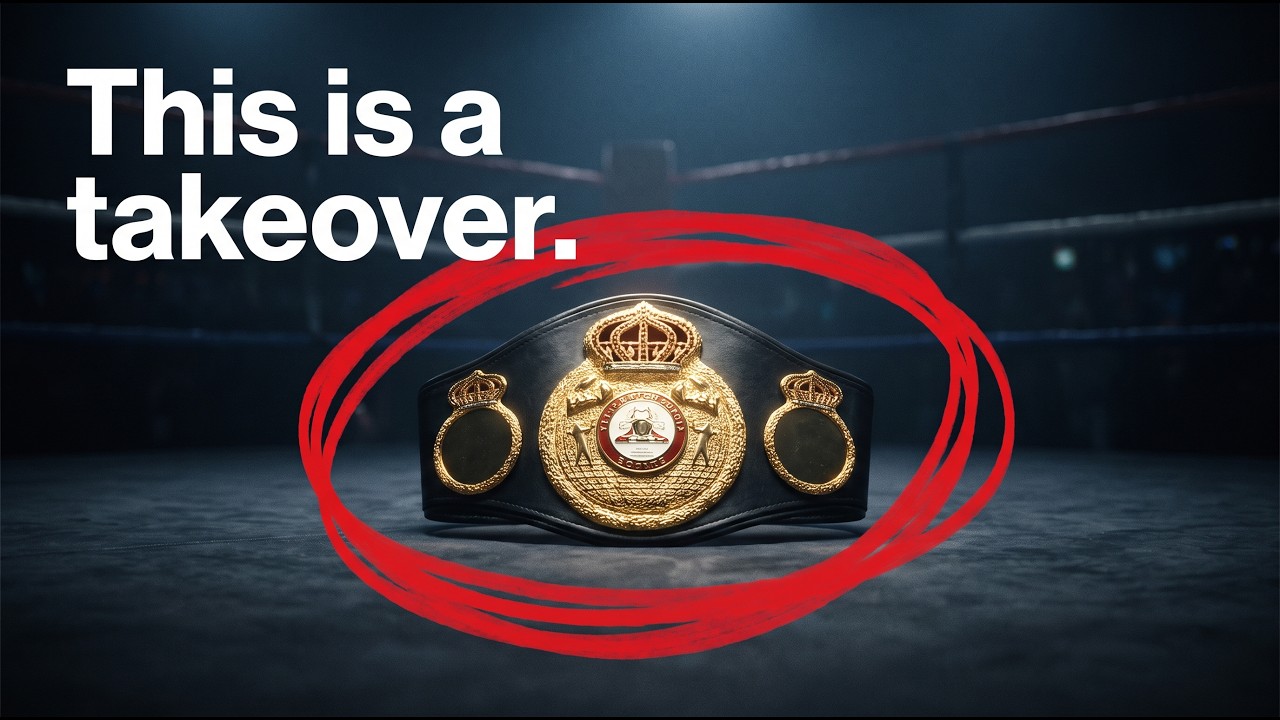
The man who turned a dying cage-fighting company into a combat-sports empire worth north of $12 billion is now coming for boxing, backed by billions in Saudi money, a media deal with Paramount, and a bill moving through the United States Congress. Dana White has spent two decades calling boxing broken. The plan taking shape isn’t to fix it. It’s to own it: the fights, the rankings, the titles, and the rules.
Key Takeaways
- The vehicle: Zuffa Boxing launched in March 2025 as a joint venture between TKO Group Holdings (parent of UFC and WWE) and Sela, a Saudi entertainment company backed by the kingdom’s Public Investment Fund.
- The proof of concept: Canelo vs. Crawford on September 13, 2025 drew more than 70,000 fans to Allegiant Stadium, a roughly $47 million gate, and over 41 million Netflix viewers.
- The law: H.R. 4624, introduced in July 2025, would legalize “Unified Boxing Organizations”: one company acting as promoter, rankings body, and sanctioning organization at once, exactly what the Ali Act of 2000 banned. It passed the House in March 2026.
- The receipts: In 2024 the UFC settled fighter antitrust claims for $375 million, over the same single-company model the new bill would legalize for boxing.
- The economics: TKO president Mark Shapiro says Saudi money carries the costs while TKO collects a management fee of roughly $10 million a year: “all margin.”
Why Does Dana White Want to Own Boxing?
Because he believes boxing’s fragmented structure, with rival promoters who won’t let the best fight the best and four sanctioning bodies (WBA, WBC, IBF, WBO) selling four “world titles” per division, can only be fixed by the model he built at the UFC: one promotion, one set of rankings, one champion. White’s story starts in boxing, not MMA. He grew up around Las Vegas, trained as a boxer, worked as a bellman in Boston, and ran boxing programs before the UFC existed. What drove him out was that structure: watching promoters protect their stars from each other while the alphabet bodies collected sanctioning fees.
In 2001, White and the Fertitta brothers bought the UFC for $2 million. Fifteen years later they sold it for $4 billion, having built the thing boxing never had: one promotion, one set of rankings, one champion per weight class. Through all of it, White kept repeating the same line: he could do boxing better. After Mayweather vs. McGregor did over four million pay-per-view buys and more than $600 million in 2017, he even showed up at Freddie Roach’s gym in a “Zuffa Boxing” shirt. Then, for years, nothing.
Who Is Funding Dana White’s Boxing Takeover?
Saudi Arabia is, through Sela, an entertainment firm backed by the kingdom’s Public Investment Fund, in a joint venture with TKO Group Holdings, and through Turki Alalshikh, the royal adviser who has spent years turning Riyadh into boxing’s bank. Alalshikh, chairman of Saudi Arabia’s General Entertainment Authority, is the force behind Riyadh Season, owner of The Ring magazine, and financier of super-fights like Fury-Usyk. He arrived as the missing piece in 2023: money without limit, meeting White’s proven operating model. In March 2025, Zuffa Boxing was born, and announcing the deal, Turki said he was handing “the flag of boxing” to the best man to carry it.
The boxing play is one arm of a much larger Saudi sports strategy. The PIF bought Newcastle United in 2021, bankrolled LIV Golf from 2022 and pushed the PGA Tour into a framework deal by 2023, while Riyadh Season staged the fights boxing politics had blocked for years, including Fury-Usyk in May 2024, the heavyweight division’s first undisputed title fight in a quarter-century. Alalshikh also bought The Ring, boxing’s self-styled “bible” since 1922, in 2023. The pattern: buy the events, then the media, then the sport itself.
| Date | Event |
|---|---|
| 2001 | Fertittas buy the UFC for $2 million; White becomes president |
| 2016 | UFC sells for $4 billion |
| 2017 | Mayweather-McGregor; White teases “Zuffa Boxing” |
| March 2025 | TKO and Saudi-backed Sela form Zuffa Boxing |
| July 2025 | Muhammad Ali American Boxing Revival Act introduced in Congress |
| September 13, 2025 | Canelo vs. Crawford launches the venture: 70,000+ fans, ~$47M gate, 41M Netflix viewers |
| March 2026 | The Revival Act passes the House by voice vote |
The launch was a statement. Canelo Álvarez vs. Terence Crawford at Allegiant Stadium drew one of the biggest crowds and gates in the sport’s history, streamed to over 41 million viewers on Netflix, and ended with Crawford becoming the first male three-division undisputed champion. Then came a long-term Paramount media deal (a dozen cards for 2026, with select fights on CBS) plus small developmental shows at the UFC Apex, the exact slow-build playbook White used on the early UFC. Paramount had already shown what it thinks TKO properties are worth: in August 2025 it agreed to pay roughly $7.7 billion over seven years for the UFC’s US media rights, ending the UFC’s pay-per-view era.
The Trojan Horse in Congress
The boldest move isn’t happening in an arena. In July 2025, the Muhammad Ali American Boxing Revival Act, H.R. 4624, was introduced in Congress with TKO’s lobbying muscle behind it and endorsements from Mike Tyson and Muhammad Ali’s widow, Lonnie Ali. On the surface it’s fighter protection: minimum per-round pay, health coverage requirements, anti-betting safeguards.
Buried inside is the real prize: “Unified Boxing Organizations,” entities legally permitted to be promoter, rankings body, and sanctioning organization at once. That is precisely the concentration of power the original Muhammad Ali Boxing Reform Act of 2000 banned, after decades of promoters exploiting fighters. The UFC never needed the law changed because the Ali Act covers boxing alone; MMA was born outside it. To import the UFC model into the ring, the statute itself has to move.
What the bill keeps, adds, and quietly demolishes:
- Keeps: the disclosure and contract protections fighters won under the original Ali Act.
- Adds: federally mandated minimum per-round pay, health coverage requirements, and anti-betting safeguards.
- Demolishes: the firewall between promoter and sanctioning body, the core reform Senator John McCain championed in 2000 after decades of fighters being exploited by the people who controlled both their bookings and their belts.
Opponents (Oscar De La Hoya, former champion Timothy Bradley, and Nico Ali Walsh, Muhammad Ali’s grandson, who has argued the bill shouldn’t carry his grandfather’s name) say a UBO leaves a fighter negotiating against the same company that controls his ranking, his title, and his schedule.
Critics also point at the receipts. In 2024, the UFC settled a $375 million antitrust lawsuit brought by fighters who accused it of suppressing pay and restricting competition. That is the very model the new bill would legalize for boxing. Reporting on early Zuffa Boxing contracts described UFC-style terms, including bans on personal sponsors, the same policy that vaporized a fighter revenue stream when the UFC adopted it in 2015. Meanwhile TKO president Mark Shapiro has told investors the venture is nearly risk-free for TKO, with Saudi money carrying the costs and TKO collecting a management fee of roughly $10 million a year:
“That’s all margin for us.” (TKO president Mark Shapiro, on the Zuffa Boxing arrangement)
Concentrated control of an entire market has a long rap sheet of its own: when the memory-chip makers coordinated one, it ended in criminal price-fixing convictions. Add the sportswashing critique (a state accused of grave human rights abuses buying goodwill through golf, football, and now boxing) and the “revival” starts to look like a hostile buyout of a sport, echoing how one billionaire’s $44 billion impulse purchase swallowed a public square.
The Critical Choice
Everyone agrees boxing is broken: fragmented, corrupt, allergic to making the best fights. The critical choice was TKO’s: rather than compete inside the sport’s rules, it moved to rewrite them. Building a great promotion under the Ali Act was available; instead, TKO put its lobbyists behind a bill that would legalize the exact promoter-sanctioning fusion the law was written to prohibit. That single decision transformed a business venture into a bid for structural ownership of an entire sport, and guaranteed that the fight over boxing’s future would be settled in Washington, in the language of money and power, not in the ring.
Where Things Stand Now
As of mid-2026, the Revival Act has passed the House, the first boxing legislation to clear it in a generation, and sits in the Senate, where opposition from fighters and promoters is loudest. Zuffa Boxing is running its Paramount-era calendar, signing champions and building prospects through its developmental shows. If the Senate passes the bill, Dana White gets what boxing has never allowed anyone: one company holding the belts, the rankings, and the checkbook. If it stalls, he’s still the best-funded promoter in the sport. Either way, he isn’t fixing boxing. He’s acquiring it.