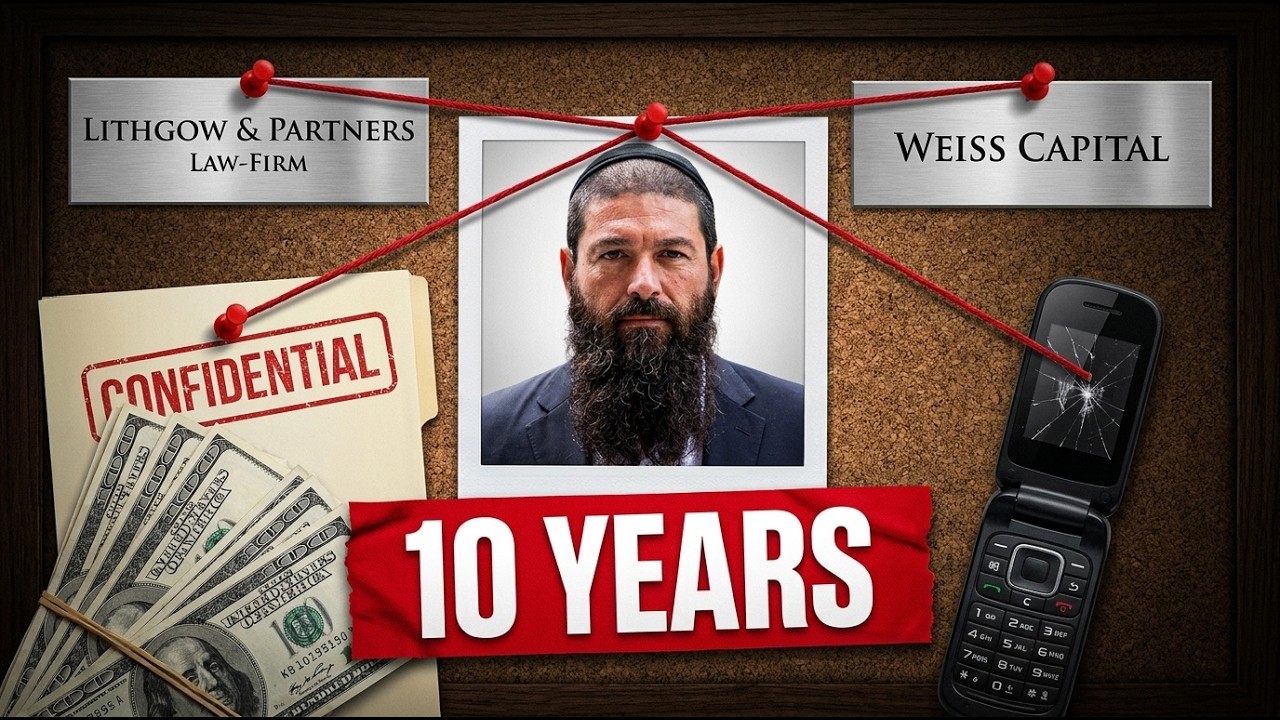
For ten years, lawyers at some of the most powerful law firms on the planet logged into their own firms’ systems, opened confidential merger documents they had no business reading, and sold what they found. Burner phones, coded language, cash kickbacks in the hundreds of thousands, trading ahead of deals worth tens of billions of dollars.
Nobody caught them until the FBI arrested 19 people in a single morning in May 2026. Thirty charged. Nearly 30 major mergers compromised. And at the center of it all: a Yale Law School graduate who spent a decade hopping between America’s top firms. Not to practice law, exactly. To rob them from the inside.
Key Takeaways
- The scale: Federal prosecutors charged 30 people in May 2026 over a decade-long ring (2013-2023) that allegedly traded ahead of nearly 30 mergers, including Cigna-Express Scripts ($54B) and J&J-Actelion ($30B).
- The source: Yale Law graduate Nicolo Nourafchan allegedly accessed confidential deal files at elite firms, including Goodwin Procter’s Amazon-iRobot documents in June 2022, while on a leave of absence.
- The takedown: The FBI arrested 19 people in a single morning on May 6, 2026; nine defendants had already pleaded guilty in secret, one as early as February 2025.
- The tradecraft: Burner phones, coded language (“How’s the rabbi?”), and traders in Russia, Israel, Panama, and Switzerland kicking profits back up the chain.
- The precedent: It echoes Matthew Kluger, the Big Law attorney who stole merger secrets for 17 years and drew a 12-year sentence in 2012, then the longest in US insider trading history.
The Yale Lawyer at the Center
On paper, Nicolo Nourafchan’s career looked perfect. A Yale Law School graduate, he spent 2013 to 2023 inside a string of America’s elite corporate firms: names like Latham & Watkins and Goodwin Procter, the firms in the room when $50 billion mergers happen.
That was the point. M&A deal documents are the most valuable information in any law firm building. If news of an acquisition leaks before the announcement, the target’s stock moves, sometimes 20, 30, even 50 percent in a day. So firms wall the files off: access controls, compliance teams, ethical rules every lawyer learns in school. Nourafchan studied those rules at Yale. According to prosecutors, he spent a decade breaking every one of them.
How Did the Insider Trading Ring Work?
Like a pyramid, according to the FBI: attorney sources at the top stole confidential merger information, middlemen passed it downward, and traders at the bottom bought stock before announcements and kicked a percentage of profits back up the chain. At the top were the sources. Nourafchan chief among them, alongside Robert Yadgarov, a New York personal injury lawyer. The two allegedly recruited other attorneys and corporate insiders with straight cash payments, hundreds of thousands of dollars for lawyers willing to betray their firms.
Below them sat middlemen, including Nourafchan’s own brother, Lorenzo, whose job was to pass tips downward while keeping distance between source and trade. At the bottom: traders scattered across California, Florida, New York, New Jersey, and overseas in Russia, Israel, Panama, and Switzerland, with profits routed through the kind of opaque plumbing that keeps offshore havens like the Cayman Islands in business. They’d buy before the announcement, sell into the jump, and kick a percentage back up the chain. Everyone got paid, so everyone stayed quiet.
The tradecraft sounds lifted from a spy film. Burner phones, regularly destroyed. Encrypted apps. Devices switched off before in-person meetings. Deals were never named: upcoming mergers were “flights” or “travel plans,” tips were “coffee,” and timing was discussed in medical and religious code. In one exchange about the Amazon-iRobot deal, prosecutors say two defendants talked like this:
“How’s the rabbi?” “We are still waiting for the doctor to check if it’s still needed.”
They were discussing a $1.4 billion acquisition as if scheduling a checkup.
The Roomba Deal That Shows How It Worked
In June 2022, Nourafchan was at Goodwin Procter, the firm advising Roomba-maker iRobot on its acquisition by Amazon. He wasn’t assigned to the deal. He wasn’t supposed to know it existed. So, according to the indictment, he took a leave of absence, and while on leave, logged back into the firm’s document management system and opened the confidential iRobot files.
Within days the information moved down the network, and traders bought iRobot stock before Amazon announced the deal in August 2022; when it did, the stock jumped and they cashed out. The acquisition itself later collapsed in early 2024 under antitrust pressure from European regulators: Amazon paid a $94 million breakup fee, iRobot cut roughly a third of its workforce, and founder-CEO Colin Angle stepped down. The insider profits had long since been banked, and the network had moved on.
| The scheme by the numbers | |
|---|---|
| Years it ran undetected | ~10 (2013-2023) |
| People charged | 30 |
| Arrested in one morning (May 6, 2026) | 19 |
| Mergers allegedly traded ahead of | Nearly 30 |
| Example deals | Cigna-Express Scripts ($54B), J&J-Actelion ($30B), Amazon-iRobot ($1.4B) |
| Illegal profits | Tens of millions of dollars |
Where Were the Law Firms?
Here’s the question that makes this story uncomfortable for an entire industry. The indictment describes six victim law firms, institutions that charge thousands of dollars an hour precisely because clients trust them with their most sensitive secrets. Every document open is logged. For ten years, attorneys were accessing deal files for transactions they weren’t working on, and that activity was being recorded somewhere.
Either nobody was checking the logs, or somebody checked and didn’t think it was a problem. Prosecutors are treating the firms as victims, deceived by their own employees. But the harder truth stands: the entire system of corporate confidentiality assumes the people inside the vault won’t steal from it. The SEC’s civil complaint says it in one line: the defendants took advantage of the special access and ethical duties that come with a law license. The people trusted the most abused that trust the longest. It’s a pattern that repeats wherever privileged access meets easy money, from a soldier betting on his own classified mission to the broader world of money and power this channel keeps returning to.
It isn’t even the first time Big Law has produced this exact crime:
- Matthew Kluger (2011): stole merger secrets across 17 years at firms including Cravath and Wilson Sonsini; his 12-year sentence was then the longest in US insider trading history.
- James O’Hagan (1997): the Minneapolis law partner whose trades ahead of a Pillsbury takeover produced the Supreme Court’s “misappropriation theory,” the legal doctrine prosecutors still use for cases exactly like this one.
- Galleon Group (2011): Raj Rajaratnam’s insider network earned him 11 years in prison and proved wiretaps work on white-collar crime.
How Did the SEC Catch the Ring?
Through pattern analysis. The SEC noticed what it always eventually notices: stocks that barely moved for months suddenly spiking on buying volume days before an acquisition. Once is coincidence. Thirty times over a decade is a pattern.
Then the flips began. Nine defendants pleaded guilty in secret while the investigation was still running. One of them, a lawyer who had worked at three major firms, as early as February 2025, more than a year before the arrests went public. For over a year, people inside the network had already turned. Everyone else had no idea the FBI was listening.
The Critical Choice
The choice that made this inevitable wasn’t any single trade. It was the decision to scale. A lone lawyer quietly front-running one deal might never surface in the data. But Nourafchan and Yadgarov allegedly built a recruitment operation: paying other attorneys for tips, layering in middlemen, wiring profits through traders on three continents. Every added layer was meant to hide the source, but every added person multiplied the trades, and every trade fed the statistical pattern the SEC ultimately spotted. The architecture designed to protect the scheme is what made it visible, and what turned a securities case into a racketeering-scale scandal.
Where Things Stand Now
Nourafchan and most co-defendants are awaiting trial on charges including securities fraud conspiracy, money laundering conspiracy, and obstruction of justice; convictions could mean decades in federal prison. Two suspects remain international fugitives, one believed to be in Russia, one in Israel. Prosecutors say the investigation is ongoing and more charges may follow.
The law firms, meanwhile, are left with the question no billable hour can answer: if it happened for ten years at the very top of the profession, where else is it happening right now?