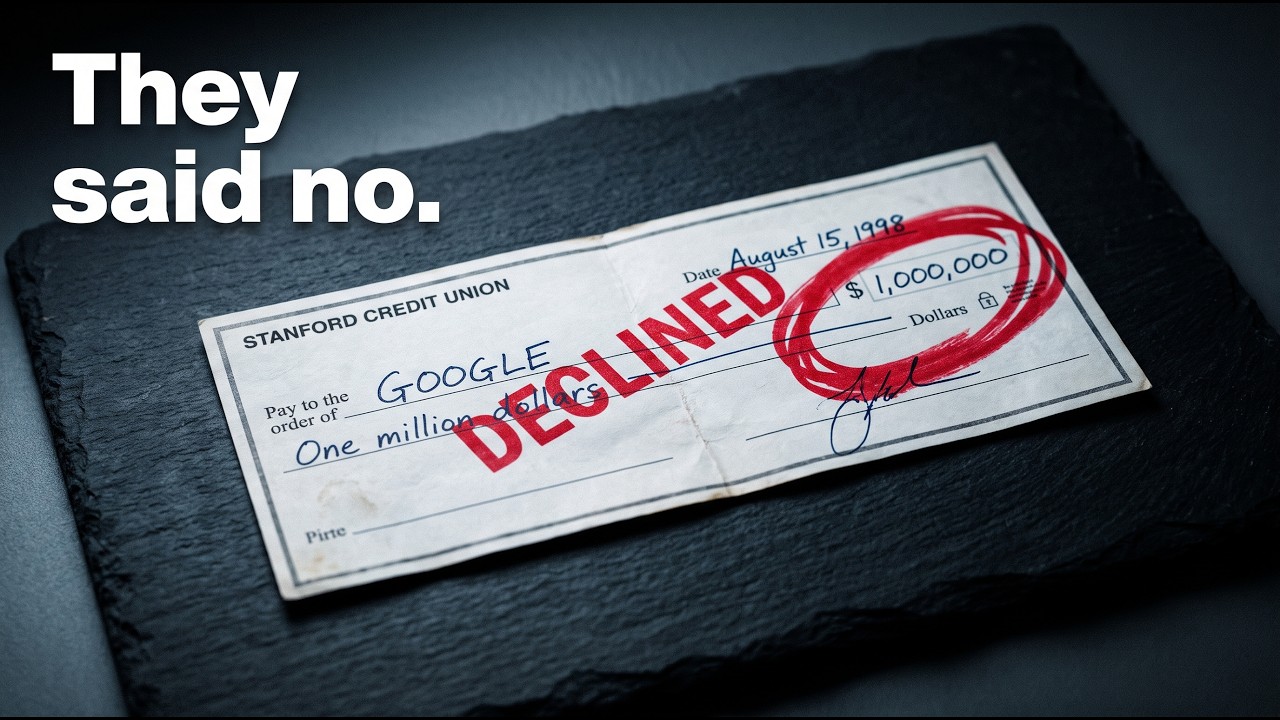
Two Stanford PhD students once tried to sell their search engine side project for $1 million so they could focus on their degrees. The buyer said no. And it haggled them down to about $750,000 first, then still said no.
That project was Google. Its buyer was Excite, one of the biggest websites on Earth at the time. Alphabet is now worth north of $2 trillion; Excite went bankrupt within three years. This is the anatomy of the worst “no” in business history, and why, at the time, it looked almost reasonable.
Key Takeaways
- Google’s founders asked Excite for $1 million: venture capitalist Vinod Khosla reportedly negotiated them down toward $750,000, and CEO George Bell still passed.
- Excite was a giant, not a minnow: founded as Architext in 1994 and public by 1996, it merged with @Home in 1999 in a deal valued around $6.7 billion.
- Excite@Home was bankrupt by 2001, and the Excite portal itself was reportedly sold out of the wreckage for about $10 million in 2002.
- Google incorporated in September 1998 on a $100,000 check from Andy Bechtolsheim, then raised $25 million from Kleiner Perkins and Sequoia in June 1999.
- AdWords launched in 2000 and became the most profitable advertising machine ever built: the monetization engine Excite never found.
- Alphabet has traded above $2 trillion: an appreciation of roughly two million times the asking price Excite refused.
How Big Was Excite in 1998?
Excite was one of the most-visited destinations on the entire web, a top-tier portal mentioned in the same breath as Yahoo, AOL and Lycos, riding a soaring stock at the height of the dot-com boom.
It’s hard to remember a web where Google was nobody, but in the late ’90s the kings were portals. Their strategy was to be a destination (news, email, horoscopes, stock quotes) and keep users on the page, where the banner ads lived. Excite had real pedigree, too: it began in 1994 as Architext, founded by six Stanford graduates including Joe Kraus, and went public in 1996 as one of the flagship names of the early commercial internet.
Search existed inside portals, but as a feature, not the point. And that distinction, feature versus point, is where a $2 trillion mistake was quietly loaded.
Why Did Excite Turn Down Google?
Because CEO George Bell didn’t believe search technology was worth even $750,000 to a portal, and by the most-told account, because the deal required Excite to rip out its own search engine and run Google’s, a condition Larry Page insisted on and Excite’s team resisted.
Rewind to the pitch. Page and Sergey Brin had built PageRank, a way of ranking pages by who linked to them, effectively letting the web vote on its own best answers. Their BackRub-turned-Google engine was visibly better than anything the portals ran. But they were academics first; the business was a distraction from their PhDs.
So they shopped it. Their most consequential pitch went to Excite, brokered by venture capitalist Vinod Khosla, whose firm had backed the portal. Asking price: $1 million for the technology. Khosla reportedly talked the students toward $750,000.
Bell passed anyway. A darker logic may have mattered too: a portal’s business model quietly preferred mediocre search, because the faster users found what they wanted, the faster they left, taking their ad impressions with them. Better search was, by the portal spreadsheet, a worse business.
Two Trajectories
| Year | Excite | |
|---|---|---|
| 1998-99 | Incorporates; raises from Andy Bechtolsheim, then Kleiner & Sequoia | Rejects the $1M offer; merges with @Home at a ~$6.7B valuation |
| 2000 | Launches AdWords, the search ads that print money | Ad market softens; cash burn accelerates |
| 2001 | Hires Eric Schmidt; revenue takes off | Excite@Home files for bankruptcy |
| 2004 | IPO at a ~$23B valuation | Brand sold off in pieces |
| Today | Alphabet: $2T+, the front door of the internet | A footnote |
Excite’s unwinding was brutally fast. The @Home merger, at the time one of the largest internet deals ever, collapsed under the dot-com crash, and Excite@Home filed for bankruptcy in late 2001. In the fire sale that followed, the broadband network assets went to AT&T for a few hundred million dollars, and the Excite portal itself reportedly fetched around $10 million: three years after deciding $750,000 was too much for Google, the whole of Excite was worth about ten times that.
Excite wasn’t even the era’s most spectacular casualty. An entire portal aristocracy fell together. AOL’s roughly $165 billion merger with Time Warner in 2000 became a byword for value destruction; Lycos sold for around $12.5 billion that same year and reportedly changed hands for a tiny fraction of that just four years later. What died was the model itself: Google’s bare search box replaced the cluttered homepage as the web’s front door.
Google’s escape velocity, meanwhile, was almost comic. In August 1998, before the company legally existed, Sun co-founder Andy Bechtolsheim wrote a $100,000 check made out to “Google Inc.”, forcing Page and Brin to incorporate just to cash it. Within a year, Kleiner Perkins and Sequoia, rival firms that rarely shared deals, split a $25 million round. And by 2000, Yahoo, the biggest portal of them all, was paying to license Google as its search provider. Those portals ended up renting the technology they could have owned outright.
Here’s the bitter irony: Excite’s fatal weakness was monetization, and the thing it declined to buy became the greatest monetization machine ever built. Google didn’t beat the portals by having more content. It beat them by being the front door, and selling ads on the doorframe.
Was This the Worst “No” in Business History?
Measured by multiple, almost certainly. No other known rejection appreciated by a factor of roughly two million. The competition is legendary, and still doesn’t come close:
- Blockbuster passed on buying Netflix for $50 million in 2000, and was bankrupt within a decade, surviving today as a single store.
- Yahoo reportedly balked at acquiring Google for a few billion dollars in 2002, and its core business eventually sold to Verizon in 2017 for about $4.8 billion, roughly the sum it once refused to pay.
- Ross Perot has said EDS passed on buying a young Microsoft in 1979, a miss he spent decades calling one of his costliest mistakes.
Each of those noes cost billions. Excite’s cost trillions, and it’s the only one where the sellers were actively begging to be bought, at a price a company of Excite’s size could have paid out of petty cash.
The Critical Choice
The easy version says George Bell made a dumb call. The truthful version is worse: Bell made a call that was rational inside a broken frame. Excite valued search by what it did for a portal, a commodity feature that, if too good, actually hurt engagement metrics, while Page and Brin valued search as the entire game. Both applied their logic correctly. Only one logic matched reality.
That’s what makes this the purest specimen in our Big Tech collection: the critical choice wasn’t laziness or ignorance. Excite had the demo, the price, and the smartest VC in the Valley pushing the deal, yet it clung to a model of the world that couldn’t see a bargain when the bargain contradicted the business. Intel would repeat the same error with Nvidia a few years later, at a thousand times the price.
What Happened Next
Bell has spent decades good-naturedly owning the story, and Khosla has told versions of it often, a Silicon Valley parable with unusually clean numbers. Excite@Home’s 2001 bankruptcy ended the portal dream; Google’s IPO in 2004, at $85 a share, started the search age in earnest. And somewhere in every pitch meeting since, a founder has invoked this story to a skeptical buyer. Statistically, the skeptic is right, except the one time per generation they’re not, and that one time pays for every mistake in history.